
Is anyone immune to the affordability crisis?

With economic anxiety reaching a 15-year high, affordability is a clear and present danger for brands and consumers alike.
But in a K-shaped economy, the top 10% of earners in the U.S. are generally thought to be doing just fine as they keep the overall economy afloat with their ever-greater share of consumer spending. Meanwhile, the rest of the country lives in a different economy altogether and struggles to make ends meet.
We wanted to test that assumption by looking at how Americans across income levels have responded to the economic ups and downs of the last 10 or so years. And it turns out that the K-shaped economic narrative has some truth to it: Americans with incomes of $200k+ (who represent ~8% of the total U.S. MONITOR sample, so not quite the top income decile but close enough for our purposes) do indeed look different than everyone else, even including so-called mass affluent or upper-middle class consumers making seemingly comfortable incomes.
In every income bracket, the trend of value-seeking shopping behavior accelerated through the pandemic and the 2022 inflationary spike. In those most volatile of times, wealthier consumers did engage in trading down. They did look for deals and they did alter their shopping behavior—for a time. But after inflationary pressures peaked, there was a return largely back to the baseline.
Meanwhile, for everyone else, these behaviors went up and stayed up even as inflationary pressures eased.
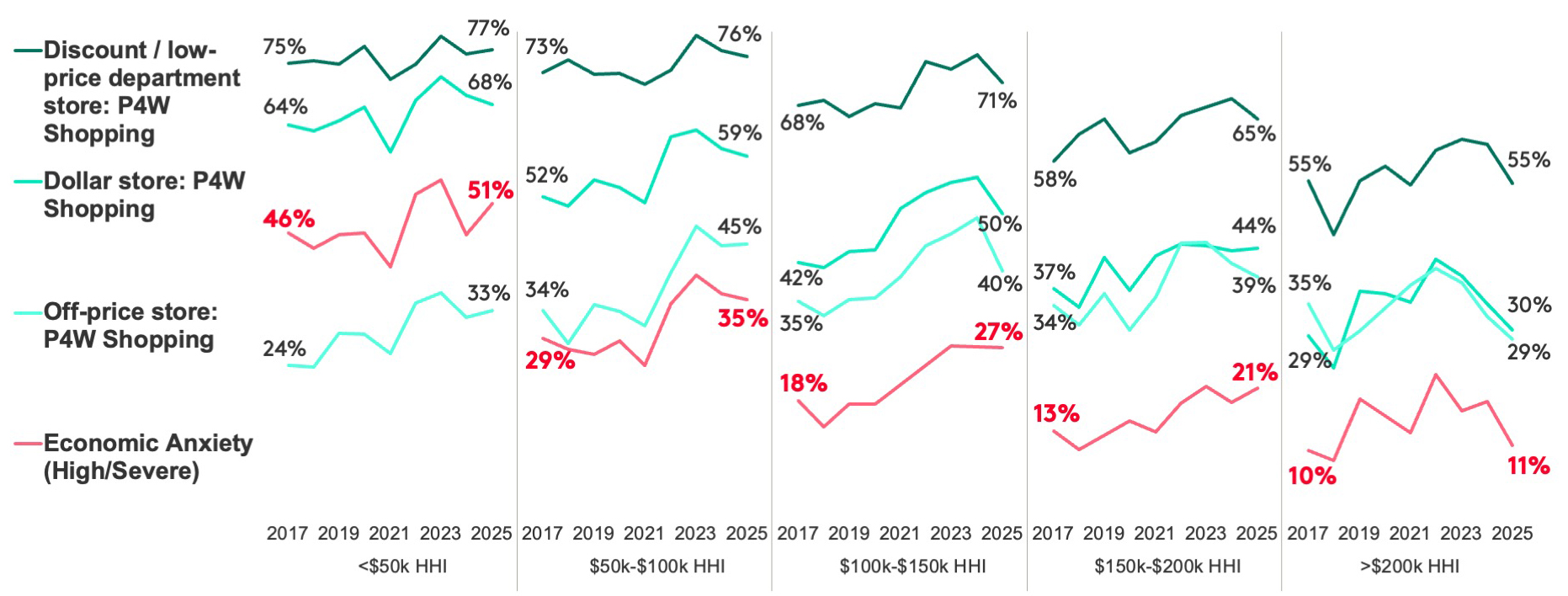
The story is distilled pretty effectively in the Economic Anxiety data (the red line in the chart). It has remined elevated for almost everyone, including folks with household incomes above $100k (and especially so for people making between $150k and $200k). Except, of course, for that wealthiest consumer segment, whose Economic Anxiety quickly spiked and just as quickly returned to the baseline.
One key takeaway for brands is that the conventional wisdom around affluence needs to be reconsidered as income brackets once thought of as upmarket look like they increasingly have more in common attitudinally and behaviorally with the mass market than they do with the upper crust.