
Gen AI: a bridge to the good life
A bridge to the good life
In our latest U.S. MONITOR Download on Generative AI, we unpack a critical insight that every brand and marketer needs to internalize: people really don’t think about AI as a “technology.”
To the consumer, it’s a personal secretary. It’s a talking encyclopedia. It’s a personal shopper. A money manager and time saver. A force multiplier. A personal bodyguard. A fixer and a maker, a coach and a confidant.
When we asked Americans to wave a magic wand and describe the AI they most wanted, they didn’t ask for faster processing or better LLMs. They asked for an expert doer and a trusted advisor. They asked for a tool that predicts and prevents problems, lowers stress, handles life’s “adminutaie,” and negotiates on their behalf for better personal outcomes. In other words, consumers see AI primarily as a lifestyle enabler.
As we move into the early majority phase of the diffusion curve, we can look to the early adopter to help us understand what to expect the future mainstream to look like. And the early adopter tells us that usage can be truly transformative both attitudinally and behaviorally. Our data shows that:
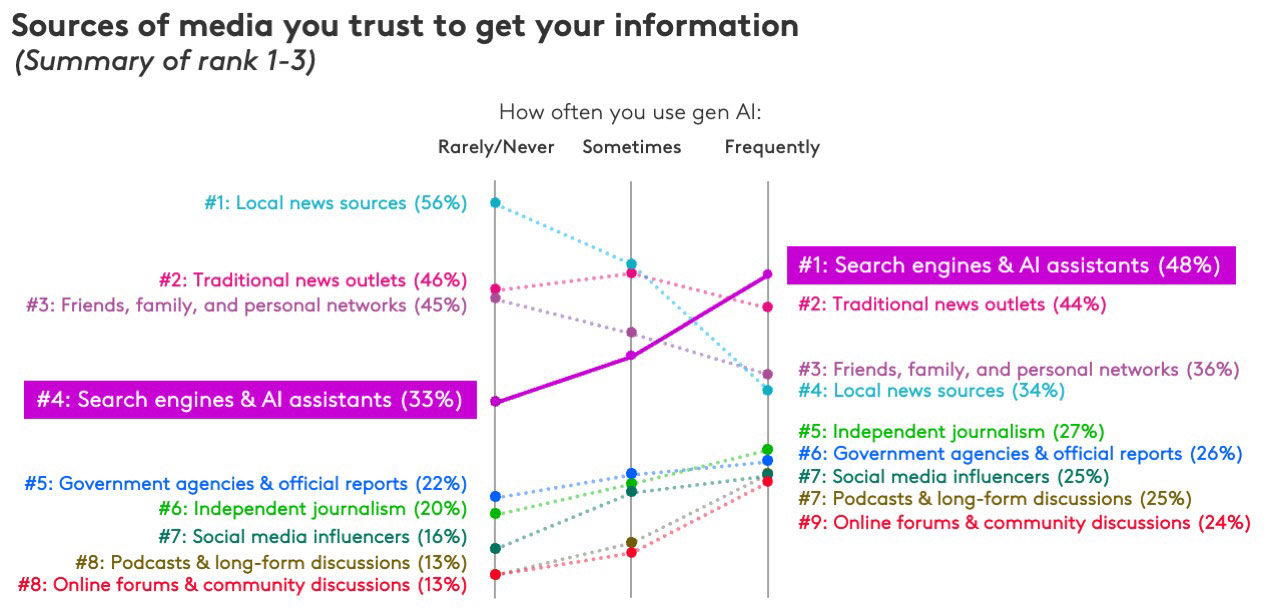
- Trust is earned through utility
While the U.S. remains tied for dead last in global excitement for AI, largely due to a pervasive climate of institutional mistrust, AI assistants leapfrog all other sources to become the #1 most trusted source of information for frequent users of gen AI.
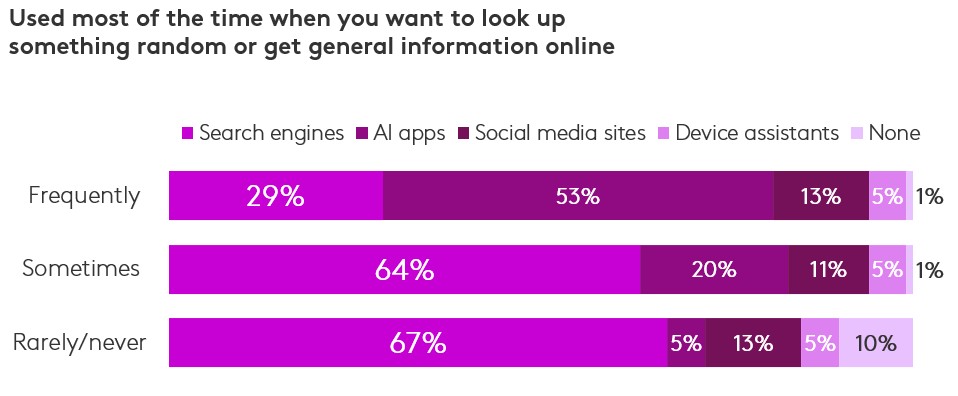
- Behavioral shifts are permanent
Search engines are still the default choice for most people, but once a consumer begins using gen AI, the behavioral paradigm quickly flips with frequent users prefer AI apps over traditional search engines as their starting point for both general queries and product research.
Going forward, people will continue fulfill a diversity of needs with AI, each of which comes with its own headwinds and tailwinds that will shape the eventual contours of AI in the consumer marketplace. These are some of the future-facing questions we’re talking about with clients:
- If frequent AI usage drives higher trust in AI sources, what happens when AI becomes the most trusted voice in a society defined by mistrust?
- AI adoption may be creating a new cultural and lifestyle fault line between users and non-users—how will your brand need to design for this fragmented marketplace?
- Given consumers’ concerns about becoming less capable, where is the line between assistance and dependence when it comes to AI usage in your brand’s category?
- When does agentic commerce reach critical mass and tip the scales in favor of agent-brokered and brand-disintermediated shopping and buying?
- What is the future of authenticity when gen AI fully erases the line between what’s real and what’s not? How will brands need to show up in culture to be perceived as authentic?