
Stability first: the new global formula for happiness

Insights from the Global MONITOR Spotlight on Happiness point to a meaningful redefinition of what drives happiness today. When examining the forces shaping people’s happiness over the past eight years, clear shifts have emerged in response to prolonged economic uncertainty and geopolitical instability. People are now more likely to prioritize the immediate, practical need for financial security, while longer‑term ideals—such as optimal health—are less likely to sit at the top of the list. In a volatile world, happiness is increasingly about making life feel manageable. Extended periods of scarcity have sharpened the desire to get ahead financially, reframing what people see as essential to wellbeing.
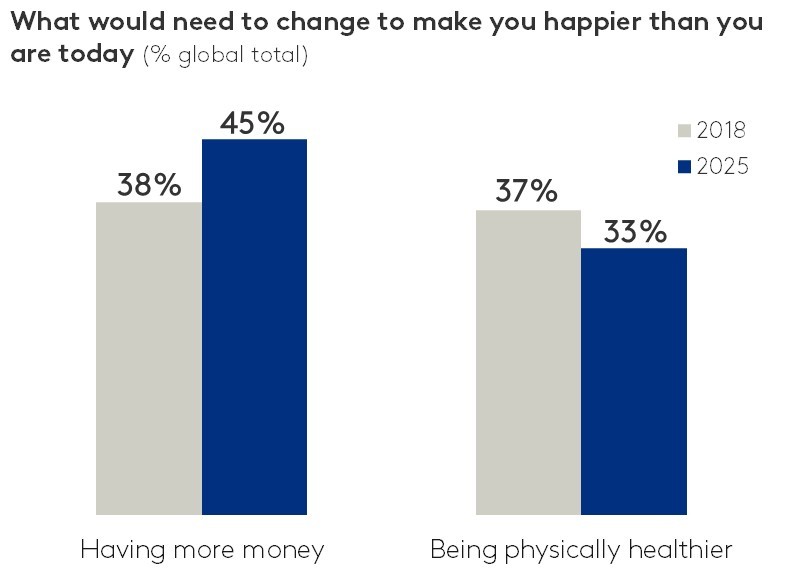

Money matters because it is the difference between coping and spiraling. For many, especially the middle classes, more income is not about upgrading life; it is about avoiding downgrade: absorbing shocks, staying autonomous and not sliding into precarity.
– Streetscaper, France
Across the world, money is viewed less as a marker of luxury and more as a foundation for stability. In different contexts, it represents the ability to withstand pressure, maintain independence and keep life on track amid rising costs and uncertainty. As traditional milestones feel harder to reach, financial resources are valued for the reassurance they provide—allowing people to plan, make choices and feel anchored rather than exposed. When supported by institutions that feel trustworthy and accessible, money takes on a broader meaning: not just what someone earns, but the confidence, resilience and sense of future‑readiness it helps create.
As a result, happiness today is anchored first in financial stability, often pushing physical health into a secondary role when basic security feels uncertain. This shift is reinforced by the reality of rising healthcare costs in many markets: before people can prioritize their health, they need the financial means to access quality care. As such, health is increasingly treated as something to manage rather than aspire to holistically. This shift signals a clear opportunity for brands: to deliver health benefits or moments of meaning that integrate seamlessly into everyday life, without adding financial burden or complexity. By lowering cost and access barriers, brands can support wellbeing and purpose in ways that feel realistic, attainable and aligned with people’s primary need for stability.
Happiness today is much more anchored to material stability and the promise of future improvement than to dimensions of self-realization, which are relegated until basic conditions are once again secure.
– Streetscaper, Argentina
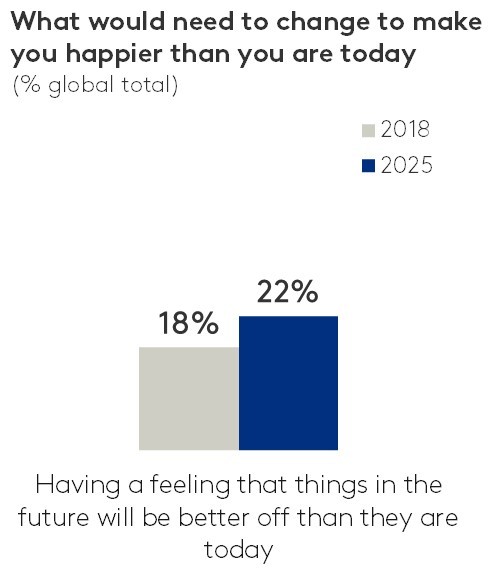
At the same time, a belief that tomorrow can be better than today has become a vital emotional anchor. When daily life feels strained or uncertain, happiness is less about present satisfaction and more about the conviction that progress is still possible. Holding onto a sense of forward movement helps people endure hardship, making sacrifices feel worthwhile as they stay invested in long‑term goals and evolving forms of aspiration.
To explore these shifts in greater depth, the Global MONITOR Spotlight on Happiness offers a global exploration of what’s driving consumer happiness today—unpacking generational and local‑market perspectives, and highlighting where and how brands can meaningfully participate.