
International Women’s Day: progress versus preservation

In recognition of International Women’s Day on March 8, 2026, the Global MONITOR team has published a comprehensive global report on women. Our analysis shows that women today are navigating a landscape defined by striking contradictions and growing complexity. Among the most notable trends and countertrends we identified is a powerful dual desire — a push for meaningful progress paired with a renewed interest in preservation.
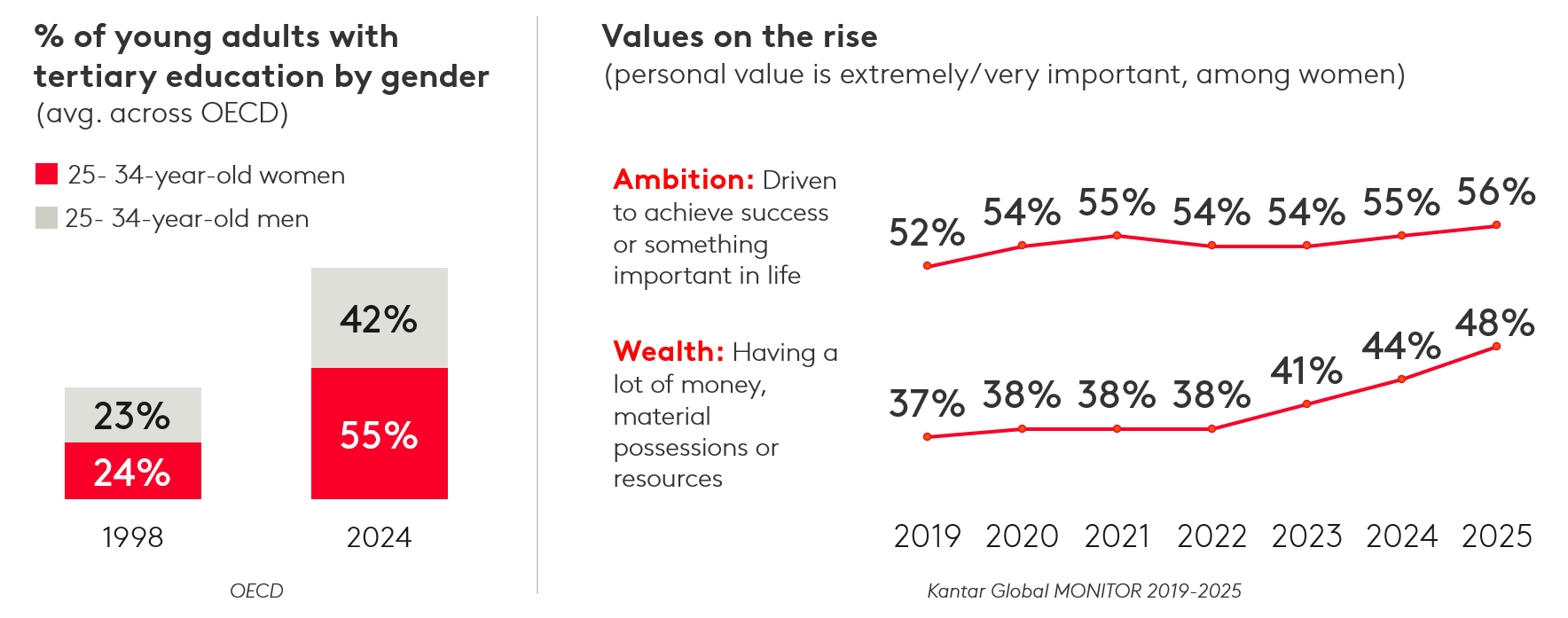
Across the globe, women continue to reach historic gains in education, corporate leadership and financial power. This momentum is being fueled in large part by younger generations: since 1998, the share of women aged 25–34 with tertiary education has more than doubled and has outpaced men. At the same time, success-driven values such as ambition and wealth have risen in importance. Of the 46 personal values tracked in Global MONITOR, wealth has shown the largest increase over the past six years. Heightened by COVID-19, inflation and ongoing economic uncertainty, a growing sense of scarcity is reshaping priorities, driving women to pursue what now feels even harder to achieve.
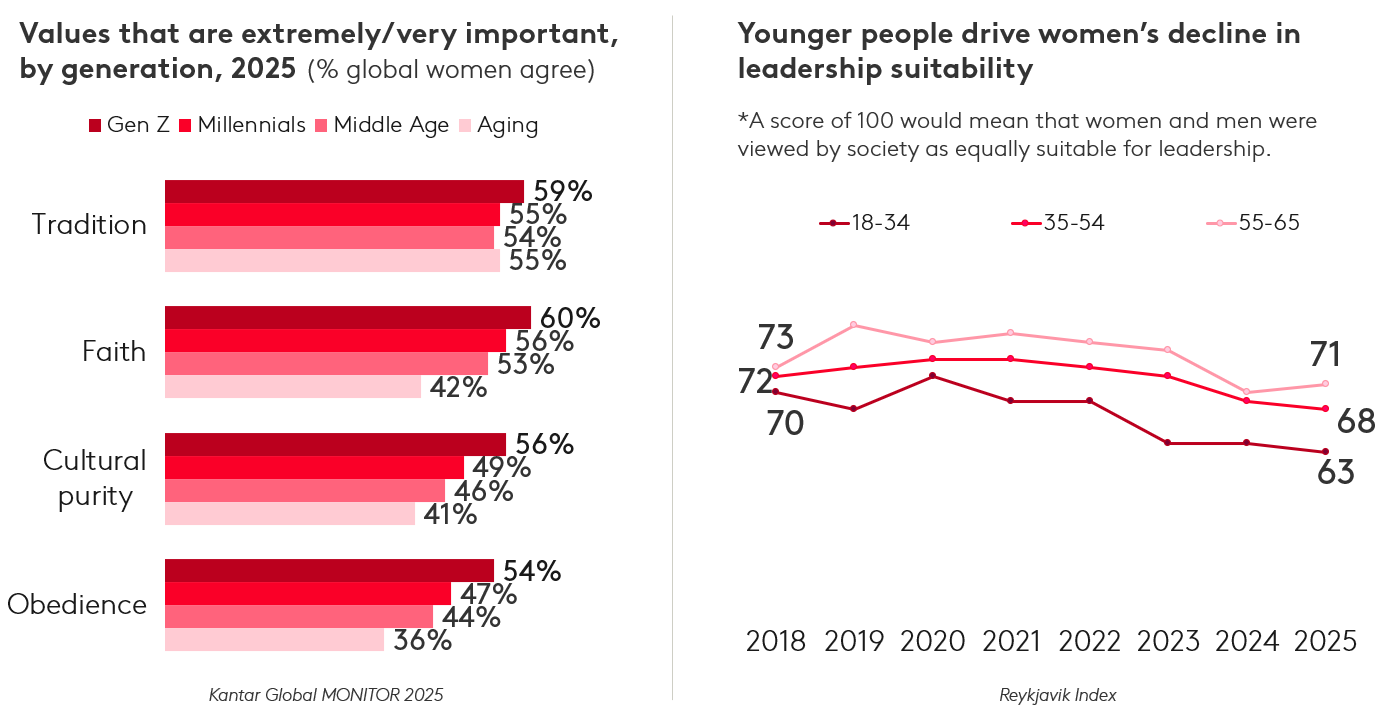
At the same time, a parallel shift is underway: growing proportions of women are gravitating toward more traditional values and norms. Since 2019, personal values rooted in tradition, faith, cultural purity and obedience have gained traction across many markets. Notably, this resurgence is being fueled by younger women. Further underscoring this shift, data from the Reykjavik Index shows that younger people—including women—are the least likely to view women as equally suitable as men for leadership roles. This perception has declined steadily since 2018, with the sharpest drop occurring among the youngest cohort.
This rising sentiment is also visible in mainstream culture, particularly through the ascent of the “tradwife” movement. For some women, traditional ways of life offer a sense of structure and clearer expectations around roles and responsibilities. For others, the pressure to “have it all” has become untenable. Many younger women are expressing frustration with workplaces that continue to demand full devotion, even as family responsibilities remain largely unchanged and disproportionately shouldered by women.
For brands, this presents a nuanced challenge: how to remain relevant to women striving for advancement while also resonating with those who are reclaiming more traditional roles. The first step is clarity. Brands must understand what their core customers value most, ensuring they do not inadvertently alienate their base by overcorrecting in one direction.
Second, brands can legitimize both perspectives by anchoring their messaging in shared underlying motivations rather than surface-level identity signals. Whether a woman prioritizes career ambition or family-centered roles, the common threads are often respect, stability and self-determination. By celebrating choice rather than prescribing a single definition of empowerment, brands can validate multiple pathways.